International Forum on Cinema-Education brings researchers and school networks together in Salvador on 3 November
On 3 November 2026, from 9:30 a.m. to 5 p.m., the auditorium of the School of Communication of the Federal University of Bahia (UFBA), on the Ondina Campus in Salvador, Brazil, hosts the 2nd International Forum on Cinema-Education. The meeting is organised by Rede Kino, the Latin American Network for Education, Cinema and Audiovisual, together with SOCINE (Brazilian Society for Film and Audiovisual Studies) and AsAECA (Argentine Association for Film and Audiovisual Studies), with support from Facom/UFBA and UFRB.
For anyone who brings films into the classroom, it is a rare day: university researchers and teams from education departments of several Brazilian states will share, in one place, how cinema is entering teacher training, the curriculum and everyday school life. Registration for attendees is open. The forum is held in Portuguese and Spanish.
Who organises it
Rede Kino brings together educators, researchers, filmmakers, schools, universities and civil society organisations working with cinema and education in Latin America. The idea came from educators at the 2nd International Meeting on Cinema and Education at UFRJ, in 2008, and the network was founded on 8 August 2009 at the School of Education of UFMG, in Belo Horizonte. The first Rede Kino Forum took place in December 2009 in Rio de Janeiro, and since 2010 the forum has met every year at CineOP, the Ouro Preto Film Festival, where the network publishes its Ouro Preto Letters. The network closely follows Law 13,006/2014, which made the screening of Brazilian films mandatory in basic education schools, a topic we discuss here on Pupilo Play in the Cinema and Education series.
In 2024, the 16th Rede Kino Forum, at the Education Meeting of the 19th CineOP, worked in groups (teacher training, screening and production, archives and curation, pedagogies) and opened a public consultation. The result became the digital book “Proposta: Programa Nacional de Cinema na Escola” (Proposal: National Programme for Cinema in Schools, in Portuguese), edited by Adriana Fresquet and published by Universo Produção, with photos of film activities in schools across several states. Recommended reading for anyone who wants to take cinema to school:
https://www.redekino.com.br/proposta-de-programa-nacional-de-cinema-na-escola/
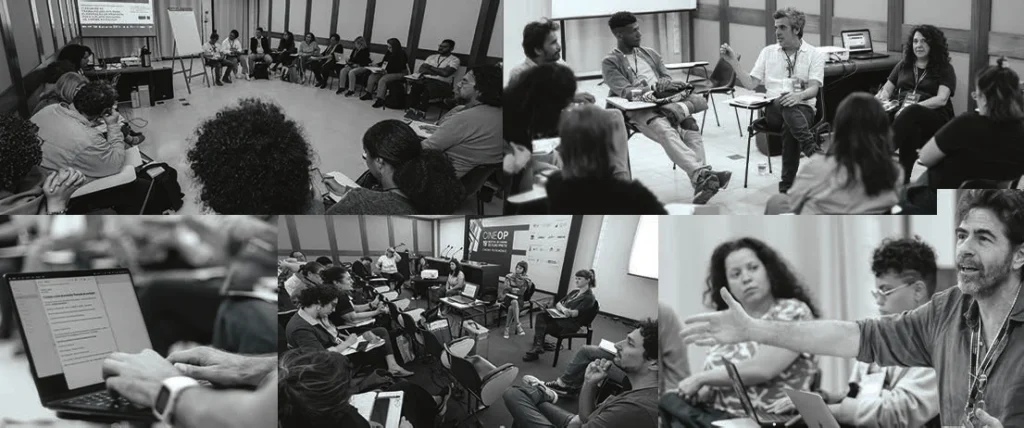
Sources: Rede Kino website (https://www.redekino.com.br/apresentacao/) and the book mentioned above.
Programme
9:30 a.m. · Opening
With Prof. Ludmila Carvalho (UFRB), from the Rede Kino coordination, and Prof. Maria Silvia Serra (National University of Rosario, Argentina), from the AsAECA coordination. Silvia Serra holds a degree in Educational Sciences from the National University of Rosario, where she directs the master’s programme in Education, Image and Contemporary Languages, and has long researched film teaching in schools.
10:30 a.m. · Keynote “Cinema and education in Latin America: creation and resistance in the face of the Dark Enlightenment”
With Prof. Adriana Mabel Fresquet (UFRJ). A full professor at the School of Education of the Federal University of Rio de Janeiro, Adriana coordinates CINEAD, the “Cinema to Learn and Unlearn” programme, which takes cinema to public schools, to the MAM-Rio Cinematheque and to the UFRJ children’s hospital. It was through CINEAD that Alain Bergala’s book “The Cinema Hypothesis”, a reference for anyone making films with children and young people, reached Brazil in 2008. She is also one of the coordinators of Rede Kino.
11:30 a.m. to 12 p.m. · Debate
2 p.m. to 3:30 p.m. · Round table 1
- FormaCE, Ceará State Department of Education. Presented by Bruno Ribeiro Marques. FormaCE is the training centre for education professionals of the Ceará state school system, created in 2022. Bruno teaches in the state system, holds a master’s in history teaching, and advocates audiovisual literacy for teachers through training and workshops.
- DAUDI, Study Group on Audiovisual Didactics for Teaching and Childhood (UFRRJ). Presented by Fábio José Paz da Rosa, who researches cinema in the design of curricula and teaching methods in basic education and teacher training, including ethnic and racial issues in the Pedagogy course.
- GELICI, Literature and Cinema Study Group (UNEB). Presented by Maria Angélica Rocha Fernandes, PhD from the UFRJ School of Education with a thesis on Jorge Amado, Bahia and cinema, who researches literature, cinema and Law 13,006 in schools.
- GEPEC, Study and Research Group on Education, Curriculum and Culture (IFES). Presented by Tony Charles Labanca Correia, author of the article “Na captura do tempo entre a escola e o cinema” (Capturing time between school and cinema, 2024).
- Tudo tem um som / Everything has a sound (UFRPE). Presented by Marcia Rezende Feitoza, who created the workshop “Tudo tem um som” on sound in audiovisual work for children, based on the idea that every sound comes from an action and that even silence is sound.
3:30 p.m. to 5 p.m. · Round table 2
- Rede Kino research: Latin American pedagogical innovations in education, cinema and audiovisual in times of digital education (UFRJ/UFMS). Presented by Marcio Blanco, cinema and education researcher, author of a chapter in the book “Cinema-Educação: políticas e poéticas” (2021).
- MOVE, Student Video Festival (Pernambuco State Department of Education). Presented by Alessandro Augusto de Andrade.
- Confluências Lab, Research and Creation Laboratory in Arts, Languages, Technologies and Knowledge in Education (UFMG). Presented by Liana Lobo Baptista.
- NICE/UFS, Interdisciplinary Centre for Cinema and Education (UFS). Presented by Caroline Sousa de Carvalho. Created in 2018 and linked to the graduate programme in Cinema of the Federal University of Sergipe, NICE takes cinema, education and human rights projects to schools in Sergipe.
- Kumã, Laboratory for Research and Experimentation in Image and Sound (UFF). Presented by Isaac Pipano, PhD in Communication from UFF. Kumã, at the UFF Department of Cinema and Video, created the project “Inventar com a Diferença” (Inventing with Difference), which trained teachers to work on citizenship and human rights through cinema, and which Isaac coordinated.
How to register as an attendee
1. Log in to the UFRB system with a gov.br account:
https://sistemas.ufrb.edu.br/sigaa/public/servicos_digitais/extensao/login.jsf
2. In the left-hand menu, click “Cursos e Eventos Abertos” (Open Courses and Events).
3. Look for “II Fórum Internacional Rede Kino de Cinema-Educação SOCINE-AsAECA” and click the green icon at the end of the event’s line.
4. Fill in the required fields (marked with an asterisk) and click “Confirmar inscrição” (Confirm registration).
Questions about the forum: kino.rede@gmail.com
Full programme as a PDF (in Portuguese), from Rede Kino:
https://pupilo.tv.br/wp-content/uploads/2026/10/programacao-forum-kino-2026.pdf
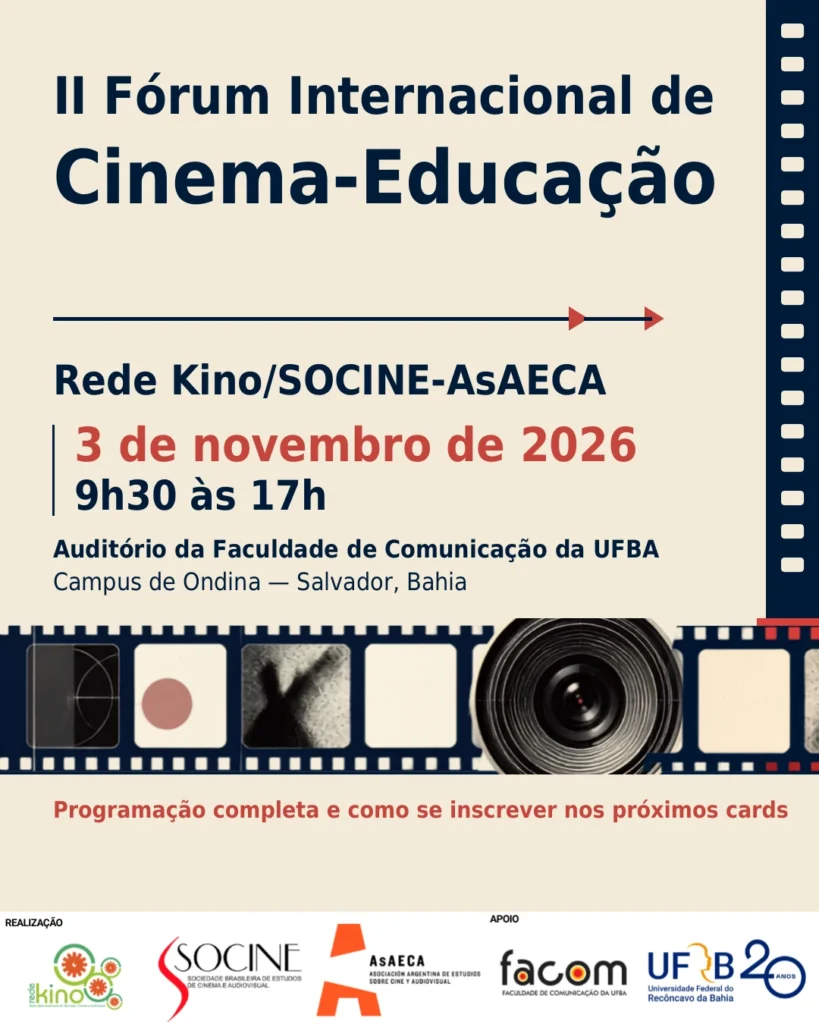
Featured image and card: Rede Kino.
To keep the conversation going at your school, see the Cinema and Education series here on Pupilo Play:
https://pupilo.tv.br/en/category/cinema-and-education/